Local SEO is the process of optimizing a business's visibility in location-based search results on Google Search, Google Maps, and other search engines.
Local SEO is the single most important search channel for any business that serves customers in a specific geographic area. This guide covers everything you need to know to dominate your local market in search.
Local SEO is a strategy that helps Google understand where your business is, what you offer, and how trustworthy you are. This improves your ranking in local search results, benefiting any business with a physical location or that serves a local area. Unlike traditional SEO, Local SEO is focused on your local geographical area.
For example, this car garage ranks #1 in the local pack and “blue link” organic results:
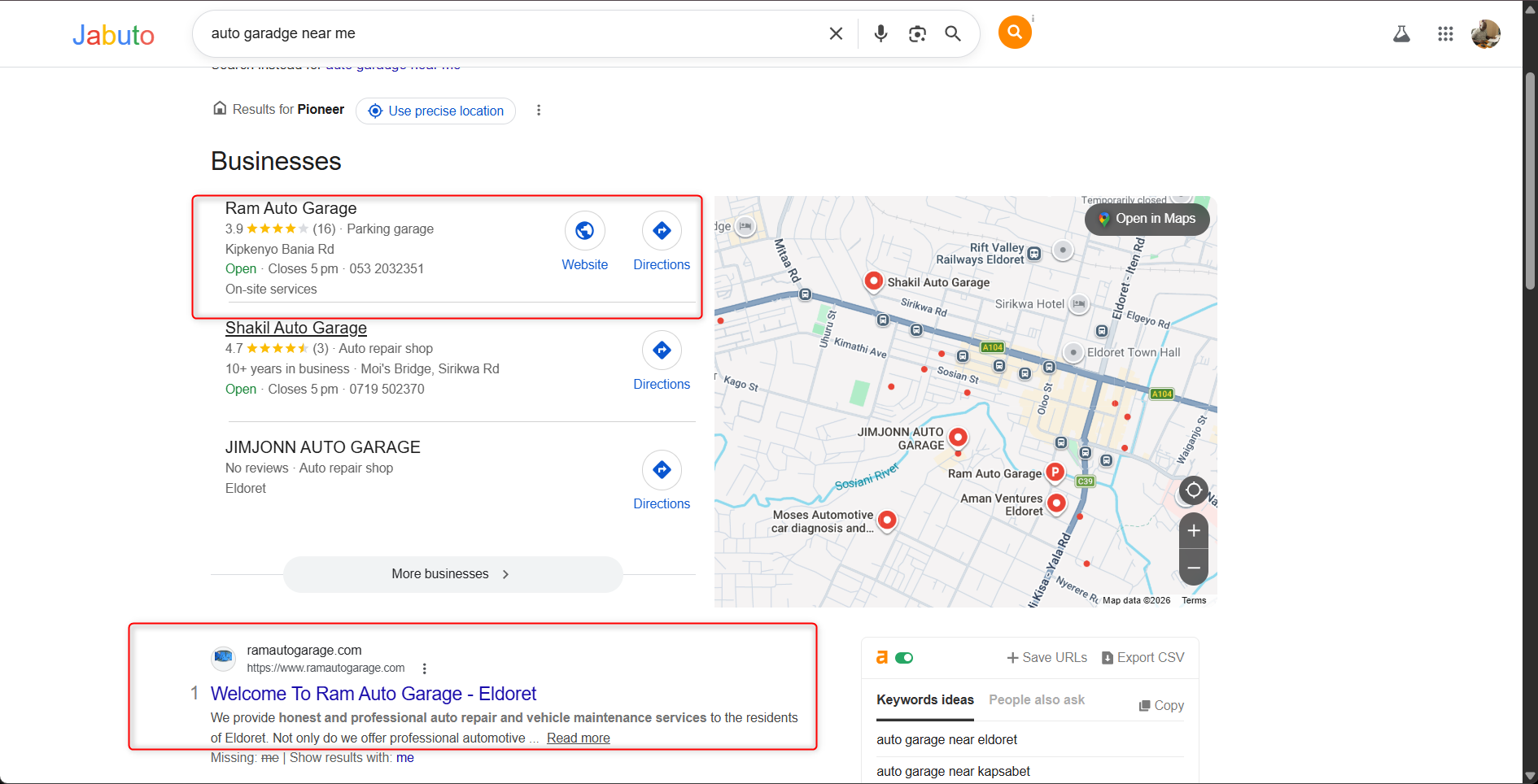
This is because it’s close to me, has exactly what I need, and has a great reputation (3.9/5 from 16 reviews).
Local SEO is the process of optimizing your website and online presence so your business appears prominently in geographically relevant searches. It covers your Google Business Profile, your website, your reviews, your local citations, and your content strategy. Every business that serves a local area — whether a single location or multiple — needs it as the foundation of their digital marketing.
Picture this:
Someone in your city needs exactly what you offer. Maybe their boiler breaks down on a cold morning. Maybe they're looking for a dentist their child can see this week, a founder looking for an accountant who understands their industry or a couple searching for a wedding venue within driving distance.
They pick up their phone and type their need into Google.
In less than three seconds, Google decides which businesses to show them.
If your business appears at the top, you get the call. If it doesn't, your competitor does.
That is local SEO in its simplest form: being the business Google chooses to show when someone nearby searches for what you offer. And the businesses that understand this and invest in it consistently are the ones that grow without being dependent on expensive advertising, referral luck, or platform algorithms they don't control.
And the scale of local search is enormous. In fact, according to Google:
In short, customers are searching for your business. If you’re not there, you’re leaving money on the table. This iswhy Local SEO benefits small businesses more.
Local SEO is a game of two halves because Google shows two types of search results for local searches. These are local pack results and organic “blue link” results. You can rank on both of them.
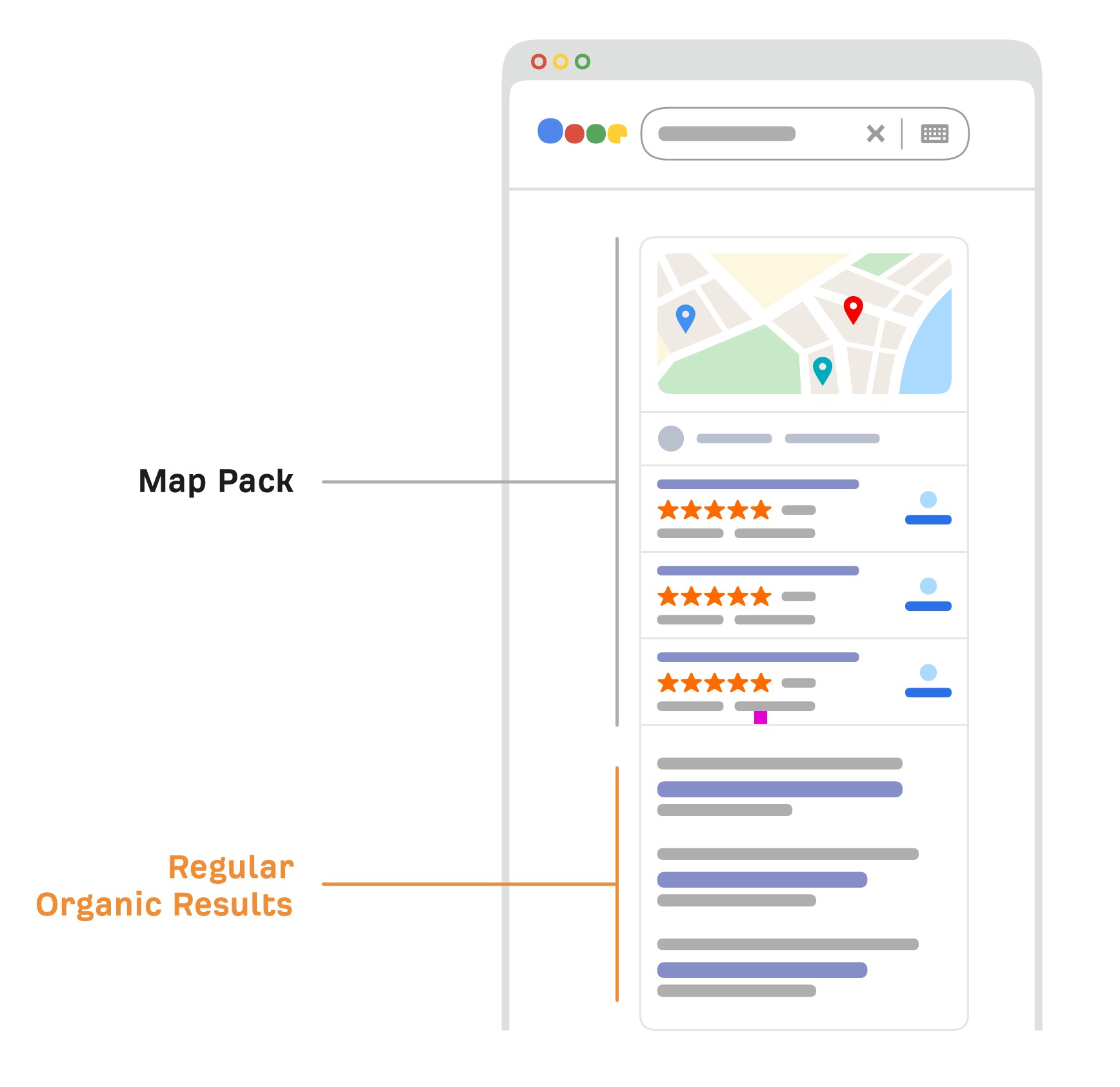
The local pack
The map pack (aka local pack) is a Google SERP feature that shows the top local business listings and a map. It often appears at the very top of Google’s search results for local searches. It shows the three businesses with their name, rating, address, hours, and a link to their website or directions. This section is prime real estate. It appears before organic results, it's the first thing most searchers see on mobile, and it drives a disproportionate share of phone calls and visits.
Organic local results
The “regular” organic search results are the “ten blue links” that we’re all familiar with in organic search. They usually appear below the map pack results. These rank based on the standard SEO signals of relevance, authority, and quality, but with an additional layer of local relevance factored in.
To dominate local search, you want to appear in both.
The local pack and the organic results are governed by overlapping but distinct sets of signals, which is why a complete local SEO strategy addresses both simultaneously.
Google decides which businesses appear in the local pack based on three factors:
You can't control your distance. But you can control your relevance and your prominence, and that's where local SEO strategy lives.
Lay a strong foundation with initial optimizations, then put systems in place to automate as much as you can going forward.
For example, reviews are important but getting more of them doesn’t have to be a chore. You can do simple things to encourage customers to leave them, such as placing cards like these on tables if you run a restaurant:

This is what I like to call passive local SEO. As long as you’re delighting your customers, your online reputation will grow on autopilot and rankings should improve.
Keep this idea in mind as you go through the rest of this guide.
Doing local SEO involves optimizing for the local pack and the regular “blue link” organic results. To do this, you optimize for local ranking factors.
Some of these are important for both the local pack and regular results, whereas others are more important for just one of them.
The local pack and the organic results are governed by overlapping but distinct sets of signals, which is why a complete local SEO strategy addresses both simultaneously.
Let’s go through the process of local SEO from start to finish.
Google Business Profile (formerly Google My Business) is the foundation of local SEO.
A Google Business Profile is a local listing with information about your business. It’s free and allows your business to appear in the map pack and Google Maps.
It is what Google uses to populate your appearance in the local pack, Google Maps, and the knowledge panel that appears when someone searches your business name directly.
36% of SEOs think your Google Business Profile is the most important ranking factor for the map pack. And 6% believe that it’s important for the “regular” organic results.
A fully optimized Google Business Profile is not optional. It is the foundation. Everything else in local SEO performs better on top of a strong profile.
Google states that customers are 70% more likely to visit businesses with a complete Business Profile. They’re also 50% more likely to consider buying from them. So it’s clear that a complete and optimized Business Profile is essential if you want to attract more business.
What a complete Google Business Profile includes:
Here are a few best practices from Google:
NAP stands for Name, Address, Phone number. These three pieces of information are the core identity data of your business online, and they need to be absolutely identical everywhere they appear:
Every place your business appears online should show exactly the same name, exactly the same address format, and exactly the same phone number.
Google cross-references your business information across hundreds of sources to verify that your business is real, that it's located where you say it is, and that the information you've provided is trustworthy. When it finds inconsistencies — "St" on one platform and "Street" on another, a different phone number on your Facebook page, an old address still appearing on a directory — it treats those inconsistencies as uncertainty about your credibility.
That uncertainty costs you rankings.
How to audit your NAP consistency:
Reviews refer to the quantity and quality of reviews on your Google Business Profile and elsewhere online.
Reviews are a powerful trust signal in local SEO. BrightLocal’s 2021 study shows that 17% of SEOs deem reviews the most important ranking factor for map pack rankings. But only 5% see them as most important for regular organic rankings.
They affect your local pack rankings directly, they appear prominently in your Google Business Profile and in AI-generated search answers, and they are often the deciding factor for a potential customer choosing between you and a competitor.
But reviews aren’t only about rankings. Getting reviews on your Google Business Profile and elsewhere builds trust with Google and customers.
Most businesses collect reviews inconsistently because they only ask when they remember. Here are a few best practices for getting more reviews from Google:
What Google looks at in your review profile:
A local citation is any online mention of your business's NAP information.
A NAP citation mentions your business’s name, address, and phone number online. They usually appear on business directories and social media profiles.
There are also NAPW citations that mention your website.
Local citations are a key ranking factor for both the map pack and regular results.
Citations appear on local business directories, industry platforms, review sites, chamber of commerce websites, local news sites, and anywhere else that lists business information.
Citations matter because they serve as corroborating evidence for Google. When dozens of credible platforms all confirm that your business exists at a specific address and can be reached at a specific number, Google's confidence in your legitimacy increases. That confidence translates into higher local rankings.
The essential citation sources for any local business:
Here are a few best practices for getting local citations:
Your website needs to reinforce your local presence, not just exist as a general business website. These are the on-site elements that matter most for local search:
a. Location-specific pages.
If you serve one area, your homepage and key service pages should include that location prominently in headings, content, and page titles. If you serve multiple areas, create a dedicated page for each location, not a generic page with the town name swapped out, but a genuinely useful page that addresses the specific needs of customers in that area.
For example, a cleaning company serving Nairobi in different neigborshoods Westlands, Thika Road, and Muthaiga, needs three separate pages, each with local-specific content, local testimonials, local team member profiles if possible, and local contact details.
b. Do local keyword research.
Local keyword research is the process of understanding how people search for the local services you offer. It’s important because you want to optimize for what people search for.
Keyword research strategies include:
i. Find service-based keywords
Most people don’t think about the different ways that others may search for what they do. For example:
If you’re a plumber, some customers will find you by typing “plumber muthaiga” into Google. But others will search for queries relating to specific services like “drain unblocking Muthaiga.”
So, you should begin by brainstorming and listing the services you offer. This will help you maximize your presence for queries your customers are searching for.
Here’s what that can look like for a plumber:
To expand this list, use the service keywords as “seeds” to find more services people are searching for.
For example, if we check the Matching terms, we can see keywords like:
If you offer those services, you may also want to consider targeting these keywords.
ii. Check search volumes
Keyword research tools show you national search volumes. If you want search volumes for your state, city, or town, you’ll have to use Google Keyword Planner.
iii. Check for local intent
Local intent means that searchers want to shop nearby. If that isn’t the case for your services, it’s not a local SEO opportunity.
To check a query for local intent, Google it and check the results. There will be two scenarios:
You can still target keywords without local intent, but it’s not a job for local SEO.
iv. Assign keywords to pages
Your homepage is unlikely to rank for all your service keywords. So you’ll need to target some with separate pages.
To assign keywords to URLs, think about which services they map to.
If they map to very different services, such as “boiler installation” and “burst pipe repair,” assign them to separate pages.
If they map to the same service, such as “drain unblocking” and “drain unclogging,” assign them to the same page.
You can learn more about this process in our local keyword research guide below.
c. Schema markup for local businesses.
LocalBusiness schema is structured data code that explicitly tells Google your business name, address, phone number, opening hours, and service area. It also enables enhanced search features. Add it to your homepage and every location page.
d. An embedded Google Map.
Embed a Google Map showing your location on your contact page and any location-specific pages. This reinforces your geographic presence to both search engines and visitors.
e. Local testimonials on your service pages.
Testimonials from customers that mention your area ("I found them while searching for a plumber in Kilimani and they were excellent") serve double duty, they add social proof for human readers and add locally relevant text that reinforces your geographic relevance to search engines.
Links act like votes for your site from other websites. Backlinks from other local websites are a strong signal in local SEO.
That’s why 31% of SEOs deem links the most important signal for ranking on regular organic search. 13% think the same for map pack rankings.
A link from a respected local publication, a community organization, or a complementary local business tells Google that you are a recognized and trusted part of your local ecosystem.
How a few best practices to earn local backlinks:
Publishing content about your local area is one of the most underused tactics in local SEO and one of the most effective for building long-term authority.
Local content does three things simultaneously:
Local content ideas that rank and convert:
Every piece of local content should link back to the most relevant service or location page on your site. The content brings in traffic from informational searches. The internal links convert that traffic toward your services.
Search behavior is shifting. A growing number of your potential customers are asking AI tools questions before they ever look at a list of results. This is where SEO now combines with AEO and GEO.
They ask ChatGPT "who are the best accountants in Nairobi" or tell Google's AI Overview "find me a reliable plumber near me." These AI systems generate answers by pulling from websites, review platforms, and business listings that have demonstrated authority and relevance in a specific area.
The businesses that win local AI search citations are the same ones that win traditional local SEO: the ones with complete, accurate, well-reviewed profiles, authoritative local content, and consistent online presence across every relevant platform.
Local SEO is not just preparation for traditional search anymore. It is the foundation for visibility across every search channel — traditional, voice, AI-generated, and whatever comes next.
What specifically helps with local AI visibility:
Let’s bring things to a close with a few local SEO tools you may find useful.
Rank Tracker lets you track up to 10,000 keyword rankings for “regular” organic search by country, state, city, and even ZIP/postal code.
Google Business Manager, formerly Google My Business, is how you manage your Google Business Profile. Signing up for it is completely free and is something every local business owner should use.
Google Search Console is a free tool for monitoring your website’s search performance. It tells you how much search traffic you’re getting, where it’s going, and what keywords it’s coming from.
Our Link Intersect tool lets you find websites that link to multiple competitors. This is useful for finding relevant local and industry-specific citations.
Grid My Business shows map pack ranking positions for a keyword in the area around your business. It’s freemium and is useful for understanding if and where local searchers are likely to see your business.
Yext is a tool for syncing and managing business information across multiple listings. It’s useful for keeping citations consistent, although you can do this manually.
Google Keyword Planner is a free keyword research tool from Google. It’s a useful source of search volume ranges at the local level.
Local SEO is not a one-time project. It is a consistent investment in your digital presence that compounds over time. Every optimized page, every review earned, every local link built keeps working for your business long after you create it.
The businesses that dominate their local markets in search are not necessarily the biggest or the most established. They are the ones who understood local SEO earliest, invested in it consistently, and built a digital presence that matches the trust and expertise they deliver to customers in real life.
BoostSiteSEO builds local SEO strategies for businesses across the USA, Europe, and Kenya. We handle the strategy, the execution, and the reporting , so you can focus on running your business.
Contact us to start building your local search dominance
What is the difference between local SEO and regular SEO?
Regular SEO targets broad keywords without geographic intent. Local SEO targets searches with a location component, "near me" searches, city-specific queries, and searches Google identifies as having local intent.
How long does local SEO take to show results?
Most businesses see meaningful improvements in local pack visibility within two to three months of consistent optimization. Competitive markets take longer. The full compounding effect of a complete local SEO strategy typically becomes clear at the six to twelve month mark.
Is Google Business Profile really that important?
Yes, without question. It is the single most important asset in local SEO. A fully optimized profile is what gets you into the local pack, the map-based results that appear at the top of local searches, and drive the majority of phone calls and visits for local businesses. Without it, you are almost invisible in local search.
How many reviews do I need to rank well locally?
There is no magic number. What matters is consistent growth in reviews over time. A business actively earning five to ten new reviews per month will consistently outrank a competitor with a higher total but no recent reviews. Recency is as important as volume.
Can I do local SEO myself or do I need an agency?
The basics are absolutely within reach for any business owner: claiming your Google Business Profile, ensuring NAP consistency, asking for reviews, and publishing occasional local content. Where an agency adds the most value is in technical SEO, comprehensive citation building, local link acquisition, and the ongoing strategy and measurement that compound results over time.
Does local SEO work for service area businesses without a physical premises?
Yes. Service area businesses — plumbers, electricians, cleaners, consultants, and others who go to the customer rather than the reverse — can optimize Google Business Profile with a service area instead of a visible address. The same local SEO principles apply with minor adjustments for the service area business model.
